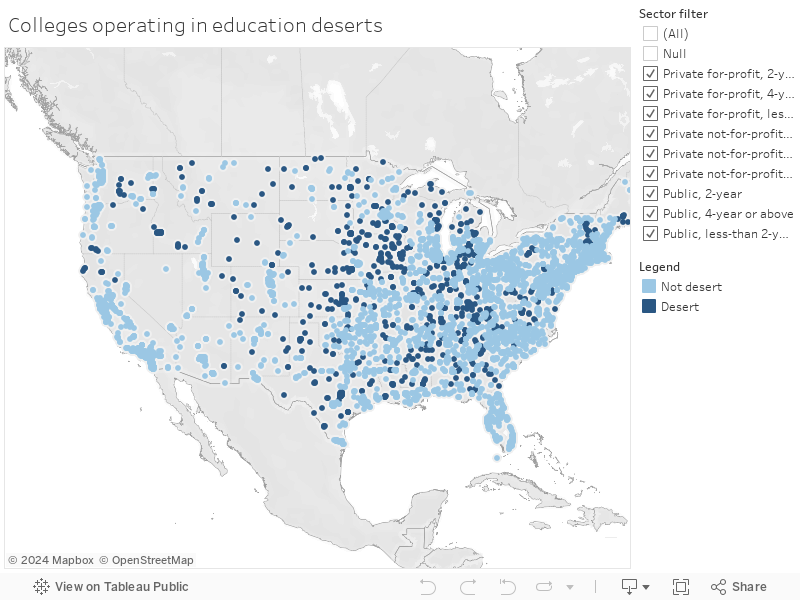
{"id":292,"date":"2017-03-31T08:58:18","date_gmt":"2017-03-31T13:58:18","guid":{"rendered":"http:\/\/web.education.wisc.edu\/nwhillman\/?p=292"},"modified":"2017-03-31T08:59:19","modified_gmt":"2017-03-31T13:59:19","slug":"community-colleges-and-upward-mobility","status":"publish","type":"post","link":"https:\/\/web.education.wisc.edu\/nwhillman\/index.php\/2017\/03\/31\/community-colleges-and-upward-mobility\/","title":{"rendered":"Community colleges and upward mobility"},"content":{"rendered":"<p>Below is a map identifying colleges operating in education deserts, or commuting zones where there are either: a) zero public colleges or b) a single community college is the only broad-access public option. This definition gives a useful but certainly not comprehensive view into communities around the country where prospective students&#8217; choices are most constrained.<\/p>\n<p>(Tableau page <a href=\"https:\/\/public.tableau.com\/profile\/publish\/WilliamMaryMobilityConference\/Sheet1#!\/publish-confirm\" target=\"_blank\">here<\/a>)<\/p>\n<div class='tableauPlaceholder' id='viz1490968739133' style='position: relative'><noscript><a href='#'><img alt='Colleges operating in education deserts ' src='https:&#47;&#47;public.tableau.com&#47;static&#47;images&#47;Wi&#47;WilliamMaryMobilityConference&#47;Sheet1&#47;1_rss.png' style='border: none' \/><\/a><\/noscript><object class='tableauViz'  style='display:none;'><param name='host_url' value='https%3A%2F%2Fpublic.tableau.com%2F' \/><param name='site_root' value='' \/><param name='name' value='WilliamMaryMobilityConference&#47;Sheet1' \/><param name='tabs' value='no' \/><param name='toolbar' value='yes' \/><param name='static_image' value='https:&#47;&#47;public.tableau.com&#47;static&#47;images&#47;Wi&#47;WilliamMaryMobilityConference&#47;Sheet1&#47;1.png' \/><param name='animate_transition' value='yes' \/><param name='display_static_image' value='yes' \/><param name='display_spinner' value='yes' \/><param name='display_overlay' value='yes' \/><param name='display_count' value='yes' \/><\/object><\/div>\n<p>                <script type='text\/javascript'>                    var divElement = document.getElementById('viz1490968739133');                    var vizElement = divElement.getElementsByTagName('object')[0];                    vizElement.style.width='100%';vizElement.style.height=(divElement.offsetWidth*0.75)+'px';                    var scriptElement = document.createElement('script');                    scriptElement.src = 'https:\/\/public.tableau.com\/javascripts\/api\/viz_v1.js';                    vizElement.parentNode.insertBefore(scriptElement, vizElement);                <\/script><\/p>\n<p>But I do not believe that having fewer choices necessarily means students&#8217; outcomes will be poor. It certainly may, but this is an empirical question that I don&#8217;t think has been closely examined. It turns out, I&#8217;m finding community colleges located in these deserts have higher than average mobility rates. And this is even after controlling for the local community zone mobility rate and a rich set of college-level covariates (including transfer-out graduation rates).<\/p>\n<p>This is from my ongoing work for an upcoming <a href=\"http:\/\/www.wm.edu\/sites\/socialmobility\/index.php\" target=\"_blank\">conference <\/a> at William &amp; Mary on higher education and social mobility. For that conference, I&#8217;ll be presenting preliminary findings from what I&#8217;ve learned after merging IPEDS, Scorecard, and mobility report card <a href=\"http:\/\/www.equality-of-opportunity.org\/data\/\" target=\"_blank\">data<\/a>. I&#8217;m still sorting through it all, but it seems pretty consistent with Chetty et al&#8217;s findings that open-access colleges (especially when they&#8217;re the only public game in town) have high mobility rates.<\/p>\n<p>I wanted to share this map to see if anybody notices anything strange. IPEDS and Scorecard don&#8217;t include satellite campuses and in some cases they merge campuses to central offices that may artificially result in a desert due to reporting issues. For example, Indiana&#8217;s Ivy Tech Community Colleges stopped reporting campus-level data in 2011 when they centralized their Program Participation Agreement, meaning it looks like the only Ivy Tech is in Indianapolis when we know they&#8217;re located all over the state. I&#8217;ve tried to adjust for some of the big problems like this one, but am still fine-tuning others (e.g., cleaning up some of the exclusively online colleges, etc.).<\/p>\n<p>Feedback welcome!<\/p>\n","protected":false},"excerpt":{"rendered":"<p>Below is a map identifying colleges operating in education deserts, or commuting zones where there are either: a) zero public colleges or b) a single community college is the only broad-access public option. This definition gives a useful but certainly not comprehensive view into communities around the country where prospective students&#8217; choices are most constrained. [&hellip;]<\/p>\n","protected":false},"author":22,"featured_media":0,"comment_status":"closed","ping_status":"closed","sticky":false,"template":"","format":"standard","meta":{"footnotes":"","_links_to":"","_links_to_target":""},"categories":[1],"tags":[],"class_list":["post-292","post","type-post","status-publish","format-standard","hentry","category-community-college-research"],"jetpack_featured_media_url":"","_links":{"self":[{"href":"https:\/\/web.education.wisc.edu\/nwhillman\/index.php\/wp-json\/wp\/v2\/posts\/292","targetHints":{"allow":["GET"]}}],"collection":[{"href":"https:\/\/web.education.wisc.edu\/nwhillman\/index.php\/wp-json\/wp\/v2\/posts"}],"about":[{"href":"https:\/\/web.education.wisc.edu\/nwhillman\/index.php\/wp-json\/wp\/v2\/types\/post"}],"author":[{"embeddable":true,"href":"https:\/\/web.education.wisc.edu\/nwhillman\/index.php\/wp-json\/wp\/v2\/users\/22"}],"replies":[{"embeddable":true,"href":"https:\/\/web.education.wisc.edu\/nwhillman\/index.php\/wp-json\/wp\/v2\/comments?post=292"}],"version-history":[{"count":0,"href":"https:\/\/web.education.wisc.edu\/nwhillman\/index.php\/wp-json\/wp\/v2\/posts\/292\/revisions"}],"wp:attachment":[{"href":"https:\/\/web.education.wisc.edu\/nwhillman\/index.php\/wp-json\/wp\/v2\/media?parent=292"}],"wp:term":[{"taxonomy":"category","embeddable":true,"href":"https:\/\/web.education.wisc.edu\/nwhillman\/index.php\/wp-json\/wp\/v2\/categories?post=292"},{"taxonomy":"post_tag","embeddable":true,"href":"https:\/\/web.education.wisc.edu\/nwhillman\/index.php\/wp-json\/wp\/v2\/tags?post=292"}],"curies":[{"name":"wp","href":"https:\/\/api.w.org\/{rel}","templated":true}]}}